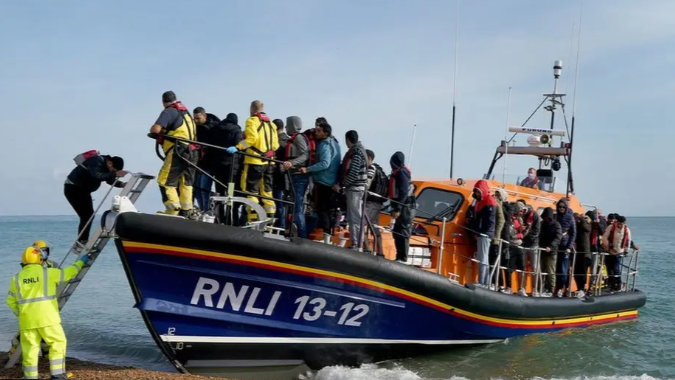

In my work with Wiltshire Governance for Good, I frequently see how small organisations, from Schools and Churches to Charities and Parish Councils, are asked to operate within governance systems that weren’t built with their operational realities in mind. The RNLI’s involvement in Channel rescues, though very different in scale, reflects the same underlying issue these local organisations face day to day – when the governance frameworks they work with lack clarity, voluntary bodies end up filling structural gaps that should be filled at the governmental level.
No one will have missed that the Royal National Lifeboat Institution (RNLI) has become a focal point in the social and political debate surrounding small‑boat crossings in the English Channel. The public’s attention typically focuses on the political controversy surrounding illegal migration. However, the RNLI’s role offers a deeper and more instructive perspective on how the UK’s governance structures manage or fail to manage the issues of humanitarian duty, border enforcement, and operational accountability.
It is frustrating – I’ve happily donated to the RNLI in the past, but viewing them as a protagonist in a political dispute isn’t helpful, although some of our more vocal politicians are happy to do so. What’s more useful is to see this as a case study in how unclear governance boundaries create systemic tension between stakeholders.
Let’s be clear: When a voluntary, donation‑funded charity becomes a critical component of national border control, it exposes structural gaps in how the state coordinates risk, resources, and responsibility. The situation is a failure of governance.
Governance Tensions: A system not designed for its real‑world pressures
You may believe them or not based on the reality on the ground – but the UK government has repeatedly emphasised border security as a strategic priority. Yet in practice, frontline maritime response relies heavily on the RNLI – an organisation whose mandate is humanitarian, not border enforcement. This reliance on the RNLI to execute state tasks highlights several governance challenges:
- Role clarity: The RNLI’s statutory duty under international maritime law obliges it to save lives at sea. It has no choice but to do this, it’s why it exists. Border Force, meanwhile, is responsible for immigration control. When situational realities blur these operational boundaries, accountability becomes diffuse and difficult to manage.
- Resource alignment: Persistent gaps in state capacity for immigration and border control, from insufficient patrol vessels to limited 24/7 coverage, create a dependency on a voluntary organisation funded by voluntary donations to fill the operational shortfalls of a state funded organisation. This is not a failure of the RNLI, but an indicator of misaligned investment and planning in Border Force by the government.
- Policy coherence: Deterrence‑based legislation, such as the Nationality and Borders Act, sits uneasily alongside the practical requirement to rescue people in distress. When humanitarian obligations and enforcement objectives are not reconciled at a policy level, frontline actors like the volunteers of the RNLI are left navigating contradictions.
This situation does not imply wrongdoing by either RNLI or Border Force. Instead, they reveal a governance ecosystem struggling to integrate multiple mandates into a coherent, joint operational model.
Compliance Pressures and Perceived Misalignment
From a compliance perspective, the RNLI operates within a clear legal and ethical framework. Its crews act in part to fulfil international conventions such as UNCLOS and SOLAS, which require the rescue of anyone in distress at sea. However, the broader system around them is less aligned.
The perception of compliance tension arises because:
- Humanitarian exemptions and enforcement frameworks operate in parallel, not in coordination
- Return agreements and bilateral arrangements are politically contested, leaving RNLI and Border Force without consistent guidance
- Mission boundaries for charities can appear stretched when they are drawn into areas adjacent to state responsibilities
Let me say again, these are not failures of the RNLI, but symptoms of a system where regulatory, humanitarian, and enforcement regimes coexist without a shared governance architecture. Many realise this and despite criticism from some quarters, public support for the RNLI has remained strong. This highlights an important governance insight:
Operational legitimacy is not derived solely from statutory authority, but from perceived integrity, clarity of purpose, and consistent delivery of public benefit.
In the same spirit that Wiltshire Governance for Good approaches its work, the RNLI’s experience underscores how civil‑society organisations can become stabilising forces when state systems are under strain – but also how they can become the focus of unwarranted criticism when governance boundaries are unclear.
What this case tells us about governance reform
The RNLI’s involvement in Channel rescues is not the cause of system dysfunction; it is an outcome of that dysfunction. A governance focused reading of the situation suggests several areas where reform could strengthen coherence and reduce friction:
- Define clearer statutory role definitions between humanitarian and enforcement bodies
- Develop stronger integrated operational frameworks that align international obligations with domestic policy
- Improve resource planning to reduce reliance on voluntary organisations for core state functions
- Mature governance models that recognise the interdependence of state and civil‑society actors in complex risk environments
These are the kinds of structural questions that matter far more than the political noise surrounding individual incidents.
In Closing
The RNLI’s role in Channel crossings illustrates how governance gaps, rather than frontline actions, drive many of the tensions in the current system. When the RNLI’s humanitarian duties, Border Force’s border enforcement, and the public’s expectations are placed together without a coherent governance framework, even the most respected institutions can become entangled in controversy.
The RNLI’s situation may be unique, but the governance lessons are universal. Whether in Schools, Churches, Charities, or Parish Councils, organisations thrive when roles are clear, risks are owned, and systems are aligned. That’s the heart of the Wiltshire Governance for Good mission – and why these national case studies matter for local leadership too.
You can donate to the RNLI here: https://rnli.org/support-us/give-money/donate
Mark.